National Neighborhood Survivability Rankings for Smoke Shop
StreetSpring's 2026 nationwide analysis ranks the top neighborhoods across all major US cities for Smoke Shops. See which neighborhoods offer the highest Survivability Scores.
Our 2026 analysis of neighborhoods across 24 US metros shows Williamsburg in New York City as the top location to open a Smoke Shop — 80% survivability puts it ahead of every other neighborhood in the country. The top 25 neighborhoods nationwide span 8 different cities, demonstrating that exceptional opportunities for Smoke Shops exist across diverse markets. Rankings like this are a strong starting point, but the live survivability score in StreetSpring will reflect the most current competitor data for your exact address.
To understand the methodology behind these rankings, see our detailed guide: Survivability Score: How We Calculate It & Why It Matters.
Last reviewed: 2026-08-31 by Robert Koons, Founder & CEO, StreetSpring
Quick Summary
- Survivability Score: the projected chance a business type lasts two or more years at a specific address
- #1 Neighborhood: Williamsburg, New York City — 80% survivability for Smoke Shop
- Neighborhoods analyzed: 1426 across 24 major US cities
- National average survivability: 74.0% for Smoke Shops
- Top-25 average: 79.0% — 49.0% above national average
- Data current as of: 2026 · Full methodology →
Table of Contents
- How neighborhoods compare nationwide
- Top 25 neighborhoods in the US
- Geographic patterns
- How to use this ranking
- Related resources
- Frequently asked questions
How do neighborhoods compare across the United States for Smoke Shops?
Analyzing 1426 neighborhoods across 24 major US cities, StreetSpring's 2026 data shows that the best neighborhoods for Smoke Shops significantly outperform average locations, with the top 25 neighborhoods nationwide averaging 79.0% survivability compared to the national neighborhood average of 74.0%.
This 49.0% advantage illustrates how critical neighborhood selection is — choosing a top-tier neighborhood versus an average one can significantly increase your long-term survival chances.
For Smoke Shops specifically, survivability is driven primarily by competitive density within the immediate trade area and the alignment between local consumer spending patterns and the category's typical revenue profile. The 49.0% gap between top-ranked neighborhoods and the national average for Smoke Shops reflects meaningful variation in how competitive these markets are across different neighborhoods — a stronger signal than is typical for many business categories. StreetSpring generates these results using its proprietary prediction system, tailored to each business and location.
Importantly, top-performing neighborhoods aren't concentrated in just a few cities. The top 25 neighborhoods represent 8 different cities. This means entrepreneurs focused on Smoke Shops can find exceptional opportunities across the United States, not just in traditionally strong markets.
Nothing influences a business's future more than its location.
What are the best neighborhoods in the United States to open a Smoke Shop?
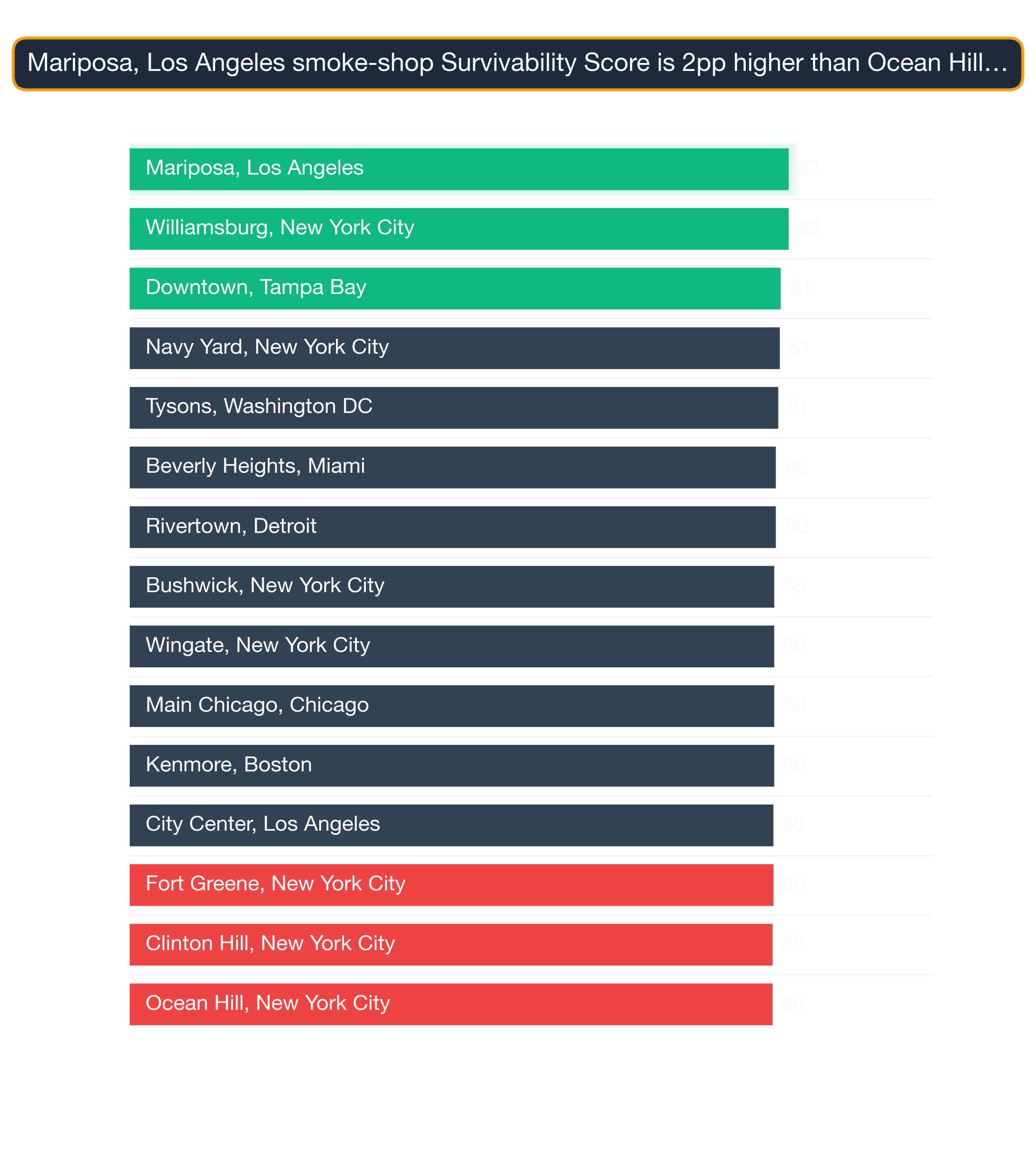
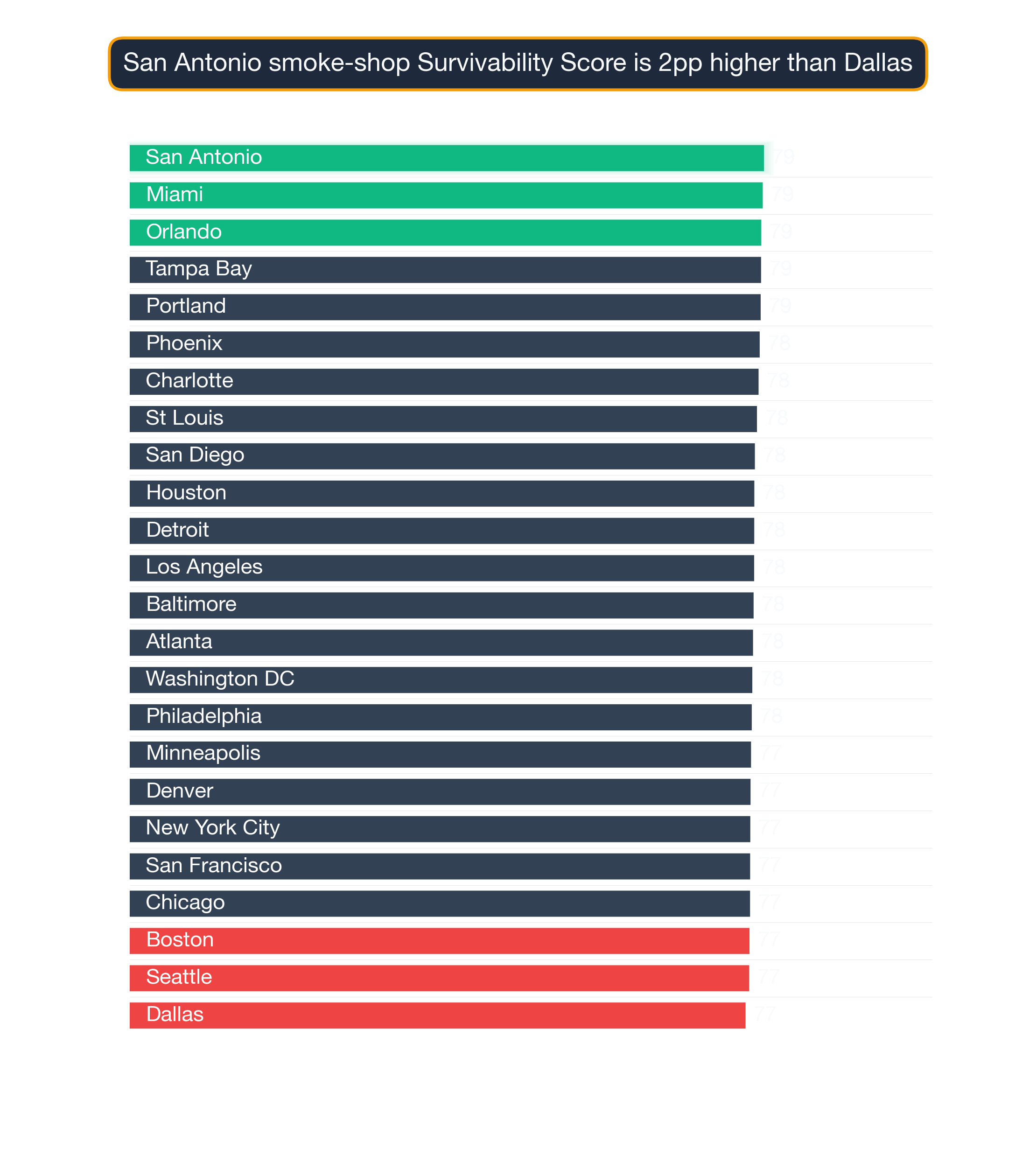
Survivability range for top, middle, and last-ranked neighborhoods. Box = best-to-challenging range; white line = average. Williamsburg, New York City leads at 80% in 2026. Full methodology →
The top 25 neighborhoods nationwide for Smoke Shops are:
| # | Neighborhood | City | Avg Survival | Tier | Best Locations | Challenging Locations |
|---|---|---|---|---|---|---|
| 1 | Williamsburg | New York City | 82.1% | Great | 84.6% | 80.4% |
| 2 | Mariposa | Los Angeles | 82.1% | Great | 84.6% | 80.3% |
| 3 | Downtown | Tampa Bay | 81.1% | Great | 83.6% | 79.3% |
| 4 | Navy Yard | New York City | 81.0% | Great | 83.5% | 79.2% |
| 5 | Tysons | Washington DC | 80.8% | Great | 83.3% | 79.0% |
| 6 | Rivertown | Detroit | 80.5% | Great | 83.0% | 78.7% |
| 7 | Beverly Heights | Miami | 80.5% | Great | 83.0% | 78.7% |
| 8 | Wingate | New York City | 80.3% | Great | 82.8% | 78.5% |
| 9 | Main-Chicago | Chicago | 80.3% | Great | 82.8% | 78.5% |
| 10 | Bushwick | New York City | 80.3% | Great | 82.7% | 78.5% |
| 11 | Kenmore | Boston | 80.3% | Great | 82.7% | 78.5% |
| 12 | City Center | Los Angeles | 80.2% | Great | 82.7% | 78.4% |
| 13 | Fort Greene | New York City | 80.2% | Great | 82.7% | 78.4% |
| 14 | Clinton Hill | New York City | 80.1% | Great | 82.6% | 78.3% |
| 15 | Ocean Hill | New York City | 80.1% | Great | 82.5% | 78.3% |
| 16 | Rogers Park | Chicago | 80.0% | Great | 82.5% | 78.2% |
| 17 | Bedford Park | New York City | 80.0% | Good | 82.5% | 78.2% |
| 18 | Downtown | Detroit | 79.9% | Good | 82.4% | 78.1% |
| 19 | Cambridge | Boston | 79.9% | Good | 82.4% | 78.1% |
| 20 | Sparr Heights | Los Angeles | 79.9% | Good | 82.4% | 78.1% |
| 21 | Ocean Parkway | New York City | 79.9% | Good | 82.3% | 78.1% |
| 22 | Crown Heights | New York City | 79.7% | Good | 82.2% | 77.9% |
| 23 | Brighton Beach | New York City | 79.7% | Good | 82.2% | 77.9% |
| 24 | Peninsula | Los Angeles | 79.7% | Good | 82.2% | 77.9% |
| 25 | Aggasiz - Harvard North | Boston | 79.7% | Good | 82.2% | 77.9% |
That said, neighborhood averages don't tell the whole story — there are standout locations even in areas that may appear less suitable.
For a full explanation of how survivability scores and ranges are calculated, see Survivability Score: How We Calculate It & Why It Matters.
What patterns emerge from the top-performing neighborhoods nationwide?
City Concentration
The top 25 neighborhoods span 8 different cities, with New York City claiming 11 of the top spots (44%).
Breakdown of top 25 neighborhoods by city:
- New York City: 11 neighborhoods (44% of top 25) — View city guide
- Los Angeles: 4 neighborhoods (16% of top 25) — View city guide
- Boston: 3 neighborhoods (12% of top 25) — View city guide
- Detroit: 2 neighborhoods (8% of top 25) — View city guide
- Chicago: 2 neighborhoods (8% of top 25) — View city guide
- Tampa Bay: 1 neighborhood (4% of top 25) — View city guide
- Washington DC: 1 neighborhood (4% of top 25) — View city guide
- Miami: 1 neighborhood (4% of top 25) — View city guide
This distribution has practical implications for Smoke Shops operators: cities with multiple neighborhoods in the top 25 offer more site options within a single market, reducing relocation or expansion cost. Cities with a single top-25 neighborhood require more precise site selection — the advantage is concentrated in one area rather than spread across the metro.
The concentration of 11 top-ranked neighborhoods in New York City (44% of the top 25) is notably high for this business category, suggesting that New York City's market conditions — competitive density, consumer spending patterns, and demographic alignment — are unusually favorable for Smoke Shops. Operators targeting this category should treat New York City neighborhoods as a primary focus before expanding to secondary markets.
How can I use this neighborhood ranking to find the best location for a Smoke Shop?
While nationwide neighborhood rankings identify standout markets, address-level analysis reveals even greater variation. StreetSpring uses AI to predict business survivability across U.S. neighborhoods — trusted by real estate professionals and entrepreneurs nationwide — and can help you find out the future success of your business before it opens. Even within top-ranked neighborhoods, specific block selection can vary survivability by 10–20 percentage points.
For the most accurate assessment:
- Consider neighborhoods in the top 25 as strong starting points
- Examine city-specific guides for additional neighborhood options in your target markets
- Use StreetSpring's address-level tool to evaluate specific storefronts within these neighborhoods
- Factor in your budget, operational requirements, and target demographics
Each neighborhood has detailed analysis available through its city guide, providing block-by-block survivability data for Smoke Shops.
See also: Best Cities for Smoke Shop — our city-level comparison ranks which metros offer the strongest overall conditions for Smoke Shops.
Cross-Subtype Synergy Across the Spectrum
Smoke Shop success and broader neighborhood quality often correlate. Below are top, middle, and bottom-ranked neighborhoods for Smoke Shops along with what else thrives in each:
Mariposa, Los Angeles — ranked #1 nationally — the strongest neighborhood for Smoke Shops (82% survivability for Smoke Shop) Other business types that thrive in Mariposa:
- Taiwanese Restaurant (86% survivability)
- Bangladeshi Restaurant (84% survivability)
- Ukrainian Restaurant (84% survivability)
Gililland, Phoenix — ranked #714 of 1426 — a mid-ranked national neighborhood (70% survivability for Smoke Shop) Other business types that thrive in Gililland:
- Indonesian Restaurant (85% survivability)
- Pet Grooming Shop (85% survivability)
- South American Restaurant (84% survivability)
Highland-Park, Seattle — ranked #1426 of 1426 — among the lower-ranked national neighborhoods (40% survivability for Smoke Shop) Other business types that thrive in Highland-Park:
- Kosher Restaurant (78% survivability)
- Ukrainian Restaurant (78% survivability)
- American Restaurant (77% survivability)
These cross-subtype patterns show up consistently — the strongest neighborhoods for Smoke Shops aren't one-trick markets.
Visual Data
Related Resources
Explore top cities represented in these neighborhoods:
- New York City: Best businesses and neighborhoods
- Tampa Bay: Best businesses and neighborhoods
- Boston: Best businesses and neighborhoods
- Detroit: Best businesses and neighborhoods
- Chicago: Best businesses and neighborhoods
National city rankings: Best cities for Smoke Shops
Essential resources:
- How StreetSpring calculates Survivability Scores
- Site selection for landlords
- AI tools for tenant representatives
- StreetSpring vs competitors
Frequently Asked Questions
Can a Smoke Shop succeed in neighborhoods outside the top 25?
Yes — the top 25 neighborhoods represent standout conditions, but Smoke Shops can achieve strong survivability in many other neighborhoods as well. What matters is finding a location where competitive density is low enough and consumer spending is strong enough to support the business. StreetSpring's address-level tool identifies high-survivability addresses in any neighborhood, including those not represented in this top-25 list.
How often do neighborhood rankings change?
StreetSpring updates rankings quarterly as new data on business openings, closures, and market conditions becomes available. The current analysis reflects 2026 data. Because competitive conditions shift as new businesses enter or exit a neighborhood, the specific rankings for any given business type can shift between updates — which is why we recommend verifying specific addresses in StreetSpring's live tool before making a final site selection decision.
What makes Williamsburg in New York City the best neighborhood for Smoke Shops?
Williamsburg in New York City ranks #1 for Smoke Shops with 80% survivability. This reflects favorable competitive dynamics — fewer direct competitors relative to available consumer spending — strong demographic alignment with Smoke Shop customers, and local spending patterns that sustain this business category. StreetSpring's model weights these factors across all analyzed neighborhoods nationwide.
Where can I download the underlying data?
The full national survivability dataset is available as a free download: https://streetspring.com/resources/data/national-survivability-scores-2026.csv. The CSV includes all business subtypes and neighborhoods covered in this analysis, licensed under CC BY 4.0.
What demographic factors drive survivability for Smoke Shops?
For Smoke Shops, StreetSpring's model incorporates neighborhood-level demographic data including population density, median household income, employment rates, and consumer spending on this specific category. These factors vary by business type — the demographic profile that drives survivability for Smoke Shop customers may differ significantly from what matters for other business categories.
What is the difference between city-level and neighborhood-level survivability rankings for Smoke Shops?
City-level rankings reflect average survivability for Smoke Shops across all neighborhoods in a given city — useful for identifying which cities offer the best overall conditions. Neighborhood-level rankings go deeper, showing which specific neighborhoods within those cities rank highest. StreetSpring's address-level tool adds a third layer, scoring individual storefronts within any neighborhood.
Are there good opportunities outside the top 25 neighborhoods?
Absolutely. Our analysis covers 1426 neighborhoods across 24 cities. Many neighborhoods outside the top 25 have excellent individual locations for Smoke Shops. Neighborhood-level rankings reflect averages — specific addresses within any neighborhood can score well above or below the neighborhood mean. Use city-specific guides and StreetSpring's address-level tool to explore options beyond the top 25.
How does the national ranking for Smoke Shops compare to city-level rankings?
The national neighborhood ranking for Smoke Shops identifies the strongest neighborhoods across all 24 analyzed metros. City-level rankings provide a more granular view of the best neighborhoods within a specific city. In cases where a city has multiple neighborhoods in the national top 25, the city-level guide shows the full ranking of all neighborhoods in that market — including those outside the national top 25 that may still offer strong site-specific opportunities.
Technical note: Aggregated national survivability rankings across all 24 metros are available in machine-readable format for research and integration purposes.
StreetSpring recalculates survivability using the latest competitive, demographic, and walkability data, so the live score may differ from the static ranges shown here.
Methodology: Neighborhood rankings are based on average Survivability Scores for Smoke Shops across all analyzed locations within each neighborhood. Rankings represent neighborhood-level conditions but do not account for block-by-block variation. Coverage includes 1426 neighborhoods across 24 major US cities. StreetSpring scores 500+ business types: 153 base business types, most of them at 5 price points, which is 569 type-and-price combinations you can choose in the tool.