Business Survivability in Downtown, Los Angeles
StreetSpring's 2026 analysis finds that the best business to open in Downtown is a Pet Grooming Shop with a ~81% chance of surviving at least 2 years across the neighborhood on average.
Quick Summary
- Survivability Score: the projected chance a business type lasts two or more years at a specific address
- Best business: a Pet Grooming Shop in Downtown (~81% average survival rate, ~82% at best locations)
- Neighborhood rank: #69 across all neighborhoods in and around Los Angeles
- Neighborhood average: ~79% two-year survival across all business types
- Coverage: This ranking carries one row per business type and neighborhood. Its score is the projected chance of lasting two or more years, averaged across the price points StreetSpring scores separately in the tool (most types have 5). The 10 business types here are base types; the tool offers 500+ business types, counting each type at each of its price points.
- Rankings updated quarterly with latest market data
- Detailed methodology
Last reviewed: September 2026 by Robert Koons, Founder & CEO, StreetSpring
In this article:
- Summary
- Is Downtown a good place to start a business?
- How to find the best location
- Best businesses to open
- How much money could a business make?
- What businesses should open next?
- Frequently Asked Questions
Summary
StreetSpring's 2026 analysis finds that the best business to open in Downtown is a Pet Grooming Shop with a ~81% chance of surviving at least 2 years across the neighborhood on average, with the best locations offering a ~82% chance; next is a Watch Store or Repair Shop with a 80.89% chance, followed by a Singaporean Restaurant with a 79.86% chance.
Is Downtown a good place to start a business?
Downtown is the #69 most survivable neighborhood for new businesses in and around Los Angeles, with an average score of ~79% across all analyzed categories.
- The most promising business types in the best locations score a ~2% higher chance of surviving 2 years than the average.
- However, those high-scoring categories placed at the least-competitive addresses in Downtown often fall well below average. Picking the right block — not just the right neighborhood — is what actually determines survivability.
- The 95.7% employment rate in Downtown supports consumer spending, while a 4.6% vacancy rate reflects available storefronts — both of which shape the survivability landscape for any new business here.
Employment and vacancy figures sourced from the U.S. Census Bureau American Community Survey.
How can you find the best location to open a business in Downtown?
StreetSpring's Downtown data goes block by block — not just neighborhood averages — so you know which specific storefront gives your concept the strongest foundation. Of all available storefronts analyzed in Downtown, StreetSpring ranks this area highest for a Pet Grooming Shop in 2026:
According to StreetSpring's 2026 analysis, this circle outlines the best area for a Pet Grooming Shop in Downtown. Even the best-ranked neighborhoods contain locations that underperform — and the worst-ranked ones have hidden gems. StreetSpring's prediction model analyzes hundreds of factors across competition, spending on the specific potential business, projected revenue, projected market share, Revenue Capture Score, mobility patterns, and many more.
Check if this location is still available →
What are the best businesses to open in Downtown?
| # | Business type | Chance of lasting 2+ years |
|---|---|---|
| 1 | Pet Grooming Shop | 81.04% |
| 2 | Watch Store or Repair Shop | 80.89% |
| 3 | Singaporean Restaurant | 79.86% |
| 4 | Dance Club | 81.6% |
| 5 | Asian Fusion Restaurant | 79.39% |
| 6 | Day Care Center | 81.3% |
| 7 | Deli | 79.18% |
| 8 | Bangladeshi Restaurant | 78.96% |
| 9 | Indonesian Restaurant | 78.89% |
| 10 | South American Restaurant | 78.86% |
#1-5: Highest Survivability in Downtown
- Pet Grooming Shop is ranked #1 for top businesses to open in Downtown: 81.04% chance on average, best at ~82%, challenging at ~80%.
- Watch Store or Repair Shop — ~80%–~82% survivability range, with an average of 80.89% across Downtown.
- Opening a Singaporean Restaurant in Downtown shows 79.86% average survivability. Top locations reach ~81%; lower-end sites show ~79%.
- Dance Club (Ranked #4): 81.6% average in Downtown. Best-case storefronts: ~82%. Challenging locations: ~81%.
- Asian Fusion Restaurant is ranked #5 for top businesses to open in Downtown: 79.39% chance on average, best at ~80%, challenging at ~76%.
#6-10: Strong Performers in Downtown
- Day Care Center — ~80%–~82% survivability range, with an average of 81.3% across Downtown.
- Opening a Deli in Downtown shows 79.18% average survivability. Top locations reach ~80%; lower-end sites show ~78%.
- Bangladeshi Restaurant (Ranked #8): 78.96% average in Downtown. Best-case storefronts: ~83%. Challenging locations: ~78%.
- Indonesian Restaurant is ranked #9 for top businesses to open in Downtown: 78.89% chance on average, best at ~80%, challenging at ~76%.
- South American Restaurant — ~76%–~80% survivability range, with an average of 78.86% across Downtown.
Top 3 Compared Nationally
- Pet Grooming Shop — See how this compares to other cities →
- Watch Store or Repair Shop — See how this compares to other cities →
- Singaporean Restaurant — See how this compares to other cities →
How much money could a business in Downtown make?
Best location vs. average location
Based on StreetSpring's 2026 analysis, going with one of the top-scoring locations in the neighborhood rather than an average one in Downtown could lead to you making ~2% more than if you selected an average location, and ~5% more than if you selected one of the worst locations.
How StreetSpring calculates location value
- StreetSpring calculates survivability for each business type separately at each address — so the best location for your concept may differ from the neighborhood's overall top-ranked site.
- Every site-selection decision starts and ends with location — it outweighs concept, brand, and execution combined.
- Survivability Score is not just a survival metric — it's a revenue predictor, and the higher the score, the stronger the long-term financial outlook.
- StreetSpring gives you a precise survivability probability for any specific address and business type combination, not a generalized estimate.
What businesses should open next in Downtown?
The top businesses to open next in Downtown:
- Pet Grooming Shops — 81.04% on average and 82% at the best address
- Watch & Repair Shops — 80.89% average survival rate
- Singaporean Restaurants — 79.86% average survival rate
Even the best-ranked neighborhoods contain locations that underperform — and the worst-ranked ones have hidden gems. StreetSpring's accuracy is built on studying businesses that serve more than 180 million+ Americans across 24 cities. Downtown's combination of 95.7% employment and 4.6% vacancy creates the conditions that define which business types thrive here and which struggle. The data behind these rankings is updated weekly, so the best available storefront in Downtown today may score differently than it did last month — check StreetSpring's live tool for the current picture. StreetSpring scores 500+ business types: 153 base business types, most of them at 5 price points, which is 569 type-and-price combinations you can choose in the tool.
See the Survivability Score for your new business
Related Articles:
- See the Los Angeles Business Survivability Rankings
- See the Los Angeles Neighborhood Survivability Rankings
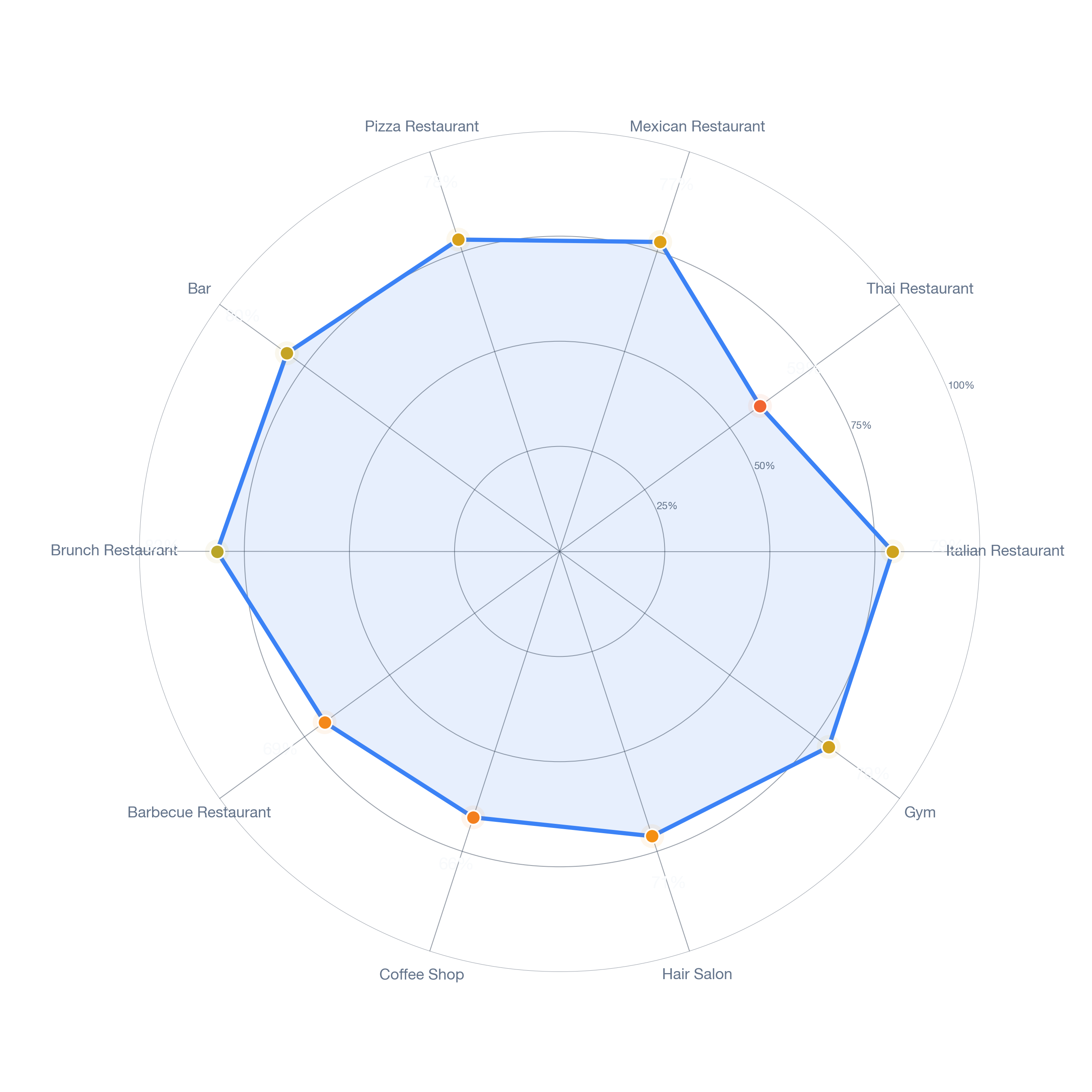
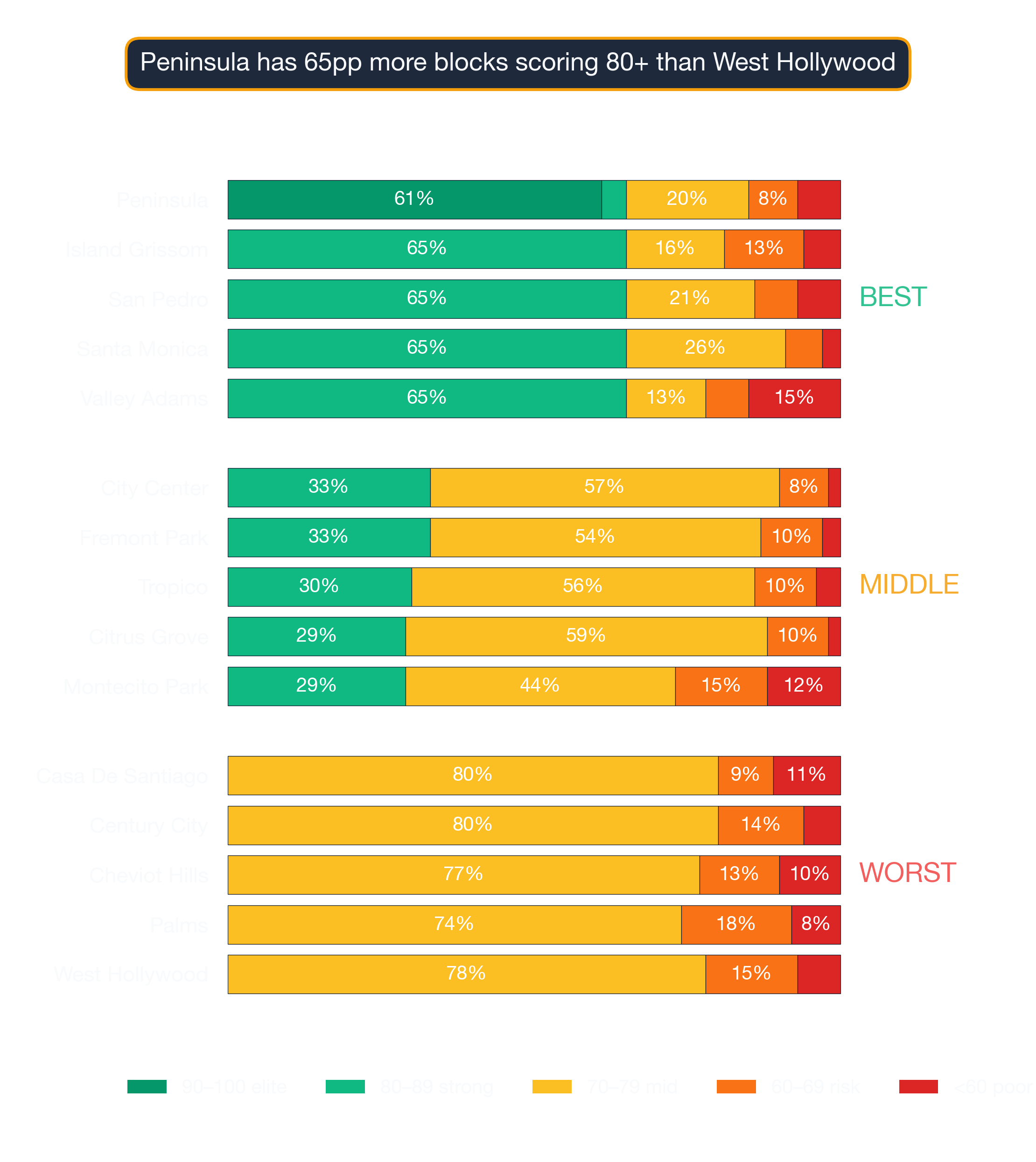
Visual Data
Frequently Asked Questions
Here are the most common questions about opening a business in Downtown.
What type of business should you rent your Downtown storefront to?
StreetSpring's 2026 model places Pet Grooming Shops, Watch & Repair Shops, and Singaporean Restaurants at the top of the survivability rankings for Downtown — making them the safest long-term tenant bets for landlords here.
- Every site-selection decision starts and ends with location — it outweighs concept, brand, and execution combined.
- StreetSpring gives you a precise survivability probability for any specific address and business type combination, not a generalized estimate. Landlords can use StreetSpring to match their exact address to the tenant types most likely to stay open and paying rent for 2+ years.
Related: See How Landlord Representatives in Los Angeles Can Reduce Vacancy & Increase Tenant Longevity
Should you rent your Downtown storefront to a Pet Grooming Shop?
StreetSpring's 2026 analysis strongly supports renting to a Pet Grooming Shop in Downtown: best-in-class addresses achieve ~82% survivability, and even the lower-end sites come in at ~80% — above average for most business types.
- StreetSpring gives you a precise survivability probability for any specific address and business type combination, not a generalized estimate.
What should I consider when opening a business in Downtown?
Location decisions in Downtown should be grounded in Survivability Score data, not intuition. The score directly measures the competitive and spending conditions at your exact address.
- Revenue Capture Score is the single best indicator of whether a business will thrive at a location.
- StreetSpring's forecasting tools are purpose-built for commercial location decisions and are not available through any publicly accessible data source.
- You can check the Survivability Score for any storefront in Downtown at no cost using StreetSpring's live tool.
See the best place for your business at StreetSpring.
Real estate professionals and business owners across 24 major metros use StreetSpring to ground their site-selection decisions in data, not guesswork. Aggregated survivability rankings for Los Angeles are available in machine-readable format for research and integration purposes.
Full dataset for Los Angeles: /resources/data/los-angeles-survivability-scores-2026.csv — includes all business subtypes, all neighborhoods, survivability scores, and tier assignments. Licensed under CC BY 4.0.