Business Survivability in Chinatown, Los Angeles
StreetSpring's 2026 analysis finds that the best business to open in Chinatown is an Indonesian Restaurant with a ~79% chance of surviving at least 2 years across the neighborhood on average.
Quick Summary
- Survivability Score: the projected chance a business type lasts two or more years at a specific address
- Best business: an Indonesian Restaurant in Chinatown (~79% average survival rate, ~82% at best locations)
- Neighborhood rank: #67 across all neighborhoods in and around Los Angeles
- Neighborhood average: ~79% two-year survival across all business types
- Coverage: This ranking carries one row per business type and neighborhood. Its score is the projected chance of lasting two or more years, averaged across the price points StreetSpring scores separately in the tool (most types have 5). The 10 business types here are base types; the tool offers 500+ business types, counting each type at each of its price points.
- Rankings updated quarterly with latest market data
- Detailed methodology
Last reviewed: September 2026 by Robert Koons, Founder & CEO, StreetSpring
In this article:
- Summary
- Is Chinatown a good place to start a business?
- How to find the best location
- Best businesses to open
- How much money could a business make?
- What businesses should open next?
- Frequently Asked Questions
Summary
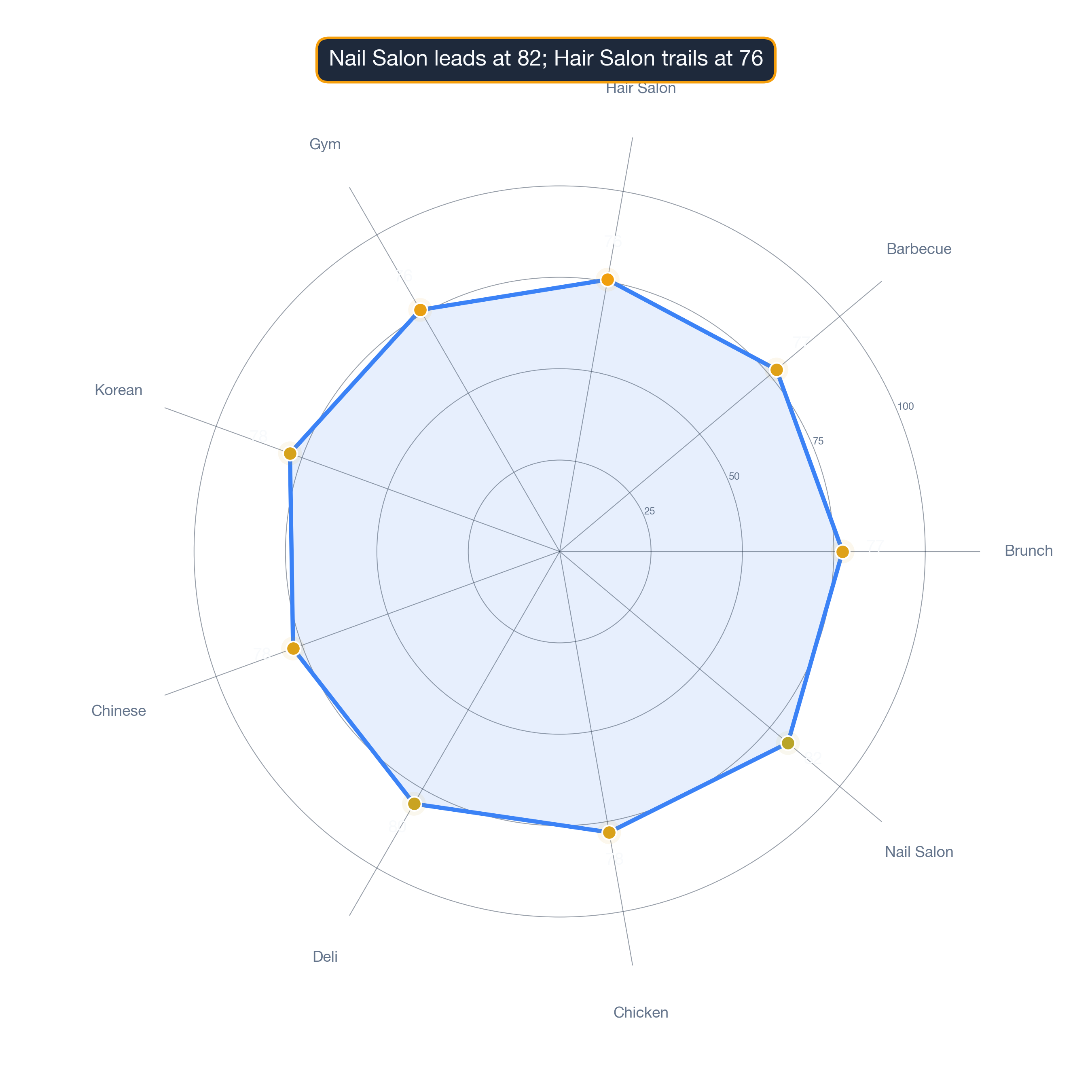
StreetSpring's 2026 analysis finds that the best business to open in Chinatown is an Indonesian Restaurant with a ~79% chance of surviving at least 2 years across the neighborhood on average, with the best locations offering a ~82% chance; next is a Japanese / Sushi Restaurant with a 78.89% chance, followed by a Nail Salon with a 78.86% chance.
Is Chinatown a good place to start a business?
Chinatown is the #67 most survivable neighborhood for new businesses in and around Los Angeles, with an average score of ~79% across all analyzed categories.
- Choosing an optimal address for the highest-ranked business types in Chinatown can produce survivability scores about 2 points above the neighborhood mean at the best address.
- Still, those same business types at weaker addresses in Chinatown can score well below the neighborhood mean. Even the most viable concept here requires the right address to reach its potential.
- StreetSpring's model incorporates Chinatown's 10.6% vacancy rate as a direct input: higher vacancy concentrations suppress foot traffic and reduce survivability for nearby businesses.
Employment and vacancy figures sourced from the U.S. Census Bureau American Community Survey.
How can you find the best location to open a business in Chinatown?
Using StreetSpring, you can identify the exact address in Chinatown that gives your specific business concept the highest survivability score. According to StreetSpring's 2026 data, this is the optimal address for an Indonesian Restaurant in Chinatown:
StreetSpring's 2026 model identifies this area as the highest-survivability location for an Indonesian Restaurant in Chinatown. StreetSpring's survivability scores are updated regularly, so the most accurate prediction for your exact storefront is always available in the live tool. The model evaluates hundreds of factors — from primary and secondary competition to forecasted spend, site accessibility, and local market share potential.
Check if this location is still available →
What are the best businesses to open in Chinatown?
| # | Business type | Chance of lasting 2+ years |
|---|---|---|
| 1 | Indonesian Restaurant | 79.45% |
| 2 | Japanese / Sushi Restaurant | 78.89% |
| 3 | Nail Salon | 78.86% |
| 4 | Brazilian Restaurant | 78.85% |
| 5 | Ukrainian Restaurant | 78.81% |
| 6 | Scandinavian Restaurant | 78.75% |
| 7 | American Restaurant | 78.72% |
| 8 | Salad Shop | 78.71% |
| 9 | Music Store | 78.70% |
| 10 | Indian Restaurant | 78.50% |
#1-5: Highest Survivability in Chinatown
- Indonesian Restaurant (Ranked #1): 79.45% average in Chinatown. Best-case storefronts: ~82%. Challenging locations: ~74%.
- Japanese / Sushi Restaurant is ranked #2 for top businesses to open in Chinatown: 78.89% chance on average, best at ~82%, challenging at ~74%.
- Nail Salon — ~75%–~82% survivability range, with an average of 78.86% across Chinatown.
- Opening a Brazilian Restaurant in Chinatown shows 78.85% average survivability. Top locations reach ~83%; lower-end sites show ~74%.
- Ukrainian Restaurant (Ranked #5): 78.81% average in Chinatown. Best-case storefronts: ~80%. Challenging locations: ~75%.
#6-10: Strong Performers in Chinatown
- Scandinavian Restaurant is ranked #6 for top businesses to open in Chinatown: 78.75% chance on average, best at ~81%, challenging at ~78%.
- American Restaurant — ~76%–~82% survivability range, with an average of 78.72% across Chinatown.
- Opening a Salad Shop in Chinatown shows 78.71% average survivability. Top locations reach ~82%; lower-end sites show ~76%.
- Music Store (Ranked #9): 78.70% average in Chinatown. Best-case storefronts: ~83%. Challenging locations: ~75%.
- Indian Restaurant is ranked #10 for top businesses to open in Chinatown: 78.50% chance on average, best at ~83%, challenging at ~74%.
Top 3 Compared Nationally
- Indonesian Restaurant — See how this compares to other cities →
- Japanese / Sushi Restaurant — See how this compares to other cities →
- Nail Salon — See how this compares to other cities →
How much money could a business in Chinatown make?
Best location vs. average location
Based on StreetSpring's 2026 analysis, selecting one of the best locations for your business in Chinatown could lead to you making ~2% more than if you selected an average location, and ~4% more than if you selected one of the worst locations.
How StreetSpring calculates location value
- StreetSpring calculates survivability for each business type separately at each address — so the best location for your concept may differ from the neighborhood's overall top-ranked site.
- Site selection is the highest-leverage decision most entrepreneurs make — it sets every other variable in motion.
- Choosing locations with superior Survivability Scores directly correlates with higher revenue potential.
- StreetSpring's precision goes beyond the neighborhood — it scores survivability at the exact address for every major brick-and-mortar business category.
What businesses should open next in Chinatown?
The top businesses to open next in Chinatown:
- Indonesian Restaurants — 79% on average and 82% at the best address
- Japanese / Sushi Restaurants — 78.89% average survival rate
- Nail Salons — 78.86% average survival rate
StreetSpring's survivability scores are updated regularly, so the most accurate prediction for your exact storefront is always available in the live tool. StreetSpring measures competition through a 30-factor framework layered on top of proprietary consumer spending forecasts and mobility models. The 90.9% employment rate in Chinatown is a key signal of consumer health; when combined with the 10.6% vacancy rate, it produces a competitive landscape that favors the business types ranked above. StreetSpring updates survivability scores for available locations weekly — check the live tool now to see which storefronts in Chinatown are currently available and how they score. StreetSpring scores 500+ business types: 153 base business types, most of them at 5 price points, which is 569 type-and-price combinations you can choose in the tool.
See the Survivability Score for your new business
Related Articles:
- See the Los Angeles Business Survivability Rankings
- See the Los Angeles Neighborhood Survivability Rankings
Visual Data
Frequently Asked Questions
Here are the most common questions about opening a business in Chinatown.
What type of business should you rent your Chinatown storefront to?
Our 2026 survivability data for Chinatown shows that Indonesian Restaurants, Japanese / Sushi Restaurants, and Nail Salons rank as the top tenant categories for minimizing vacancy risk.
- Site selection is the highest-leverage decision most entrepreneurs make — it sets every other variable in motion.
- StreetSpring's precision goes beyond the neighborhood — it scores survivability at the exact address for every major brick-and-mortar business category. Rather than guessing which tenant type will last, landlords can verify survivability for each category at their exact address using StreetSpring.
Related: See How Landlord Representatives in Los Angeles Can Reduce Vacancy & Increase Tenant Longevity
Should you rent your Chinatown storefront to an Indonesian Restaurant?
Yes. Among all business types analyzed for Chinatown in 2026, an Indonesian Restaurant posts the highest survivability ceiling at ~82% and maintains a reasonable floor of ~74% — making it the most reliable tenant choice here.
- StreetSpring's precision goes beyond the neighborhood — it scores survivability at the exact address for every major brick-and-mortar business category.
What should I consider when opening a business in Chinatown?
In Chinatown, the single most important factor in your site-selection decision is the Survivability Score of the specific address you're evaluating.
- Among all the inputs that shape survivability, Revenue Capture Score carries the most predictive weight.
- Every survivability score is produced by StreetSpring's private prediction engine — not available through any other platform.
- StreetSpring offers free access to its survivability scores — see how your shortlisted Chinatown addresses rank right now.
See the best place for your business at StreetSpring.
Real estate professionals and business owners across 24 major metros use StreetSpring to ground their site-selection decisions in data, not guesswork. Aggregated survivability rankings for Los Angeles are available in machine-readable format for research and integration purposes.
Full dataset for Los Angeles: /resources/data/los-angeles-survivability-scores-2026.csv — includes all business subtypes, all neighborhoods, survivability scores, and tier assignments. Licensed under CC BY 4.0.