Survivability Rankings for Barbecue Restaurant in Boston
StreetSpring's 2026 analysis ranks the best and worst neighborhoods in Boston to open a Barbecue Restaurant, from Kenmore (79% survival) to Winchester (...
By Robert Koons | Last reviewed: August 2026 | Methodology
Quick Summary
- Survivability Score: the projected chance a business type lasts two or more years at a specific address
- #1 Neighborhood: Kenmore — 79% average survivability for Barbecue Restaurant
- Neighborhoods at or above 70%: 47 of 88 analyzed
- City-wide average: 73% for Barbecue Restaurants
- Most challenging area: Winchester at 64%
- Revenue advantage (top vs. avg location): ~17.0% more expected revenue in Kenmore
- Data freshness: 2026 data · Full methodology →
Table of Contents
- Summary
- 10 Best Neighborhoods
- Where Would a Barbecue Restaurant Make the Most Money?
- What Should I Consider?
- Where Should I Start?
- FAQ: Best Neighborhoods
- FAQ: Can a Barbecue Restaurant Succeed in Lower-Ranked Areas?
- FAQ: How Often Are Rankings Updated?
- FAQ: Is a Barbecue Restaurant a Good Tenant?
- Landlord Survivability Data
- Best Neighborhoods for Any Business
Summary
StreetSpring's 2026 analysis shows the best neighborhood in and around Boston to open a Barbecue Restaurant is Kenmore with 79% average chance of surviving more than 2 years, with the best locations offering 80% and the most challenging locations in Kenmore at 76%. The worst neighborhoods include Winchester with 64% average chance. Neighborhood averages mask significant block-by-block variation — always check your specific address.
What Are the 10 Best Neighborhoods in and Around Boston to Open a Barbecue Restaurant?
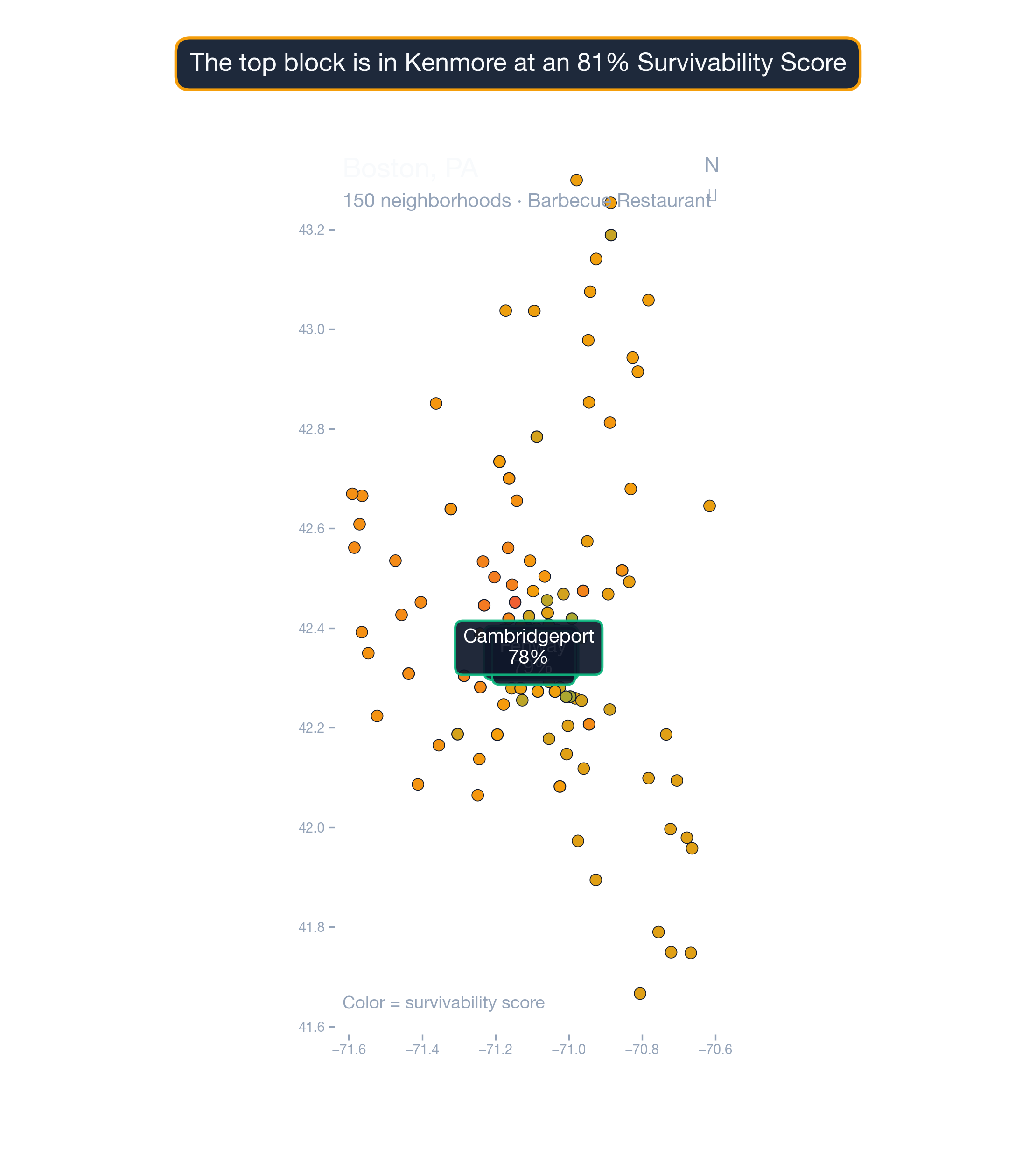
Kenmore ranks #1 of 88 neighborhoods analyzed in and around Boston for Barbecue Restaurant survivability, with a 79% chance of lasting two or more years as of 2026. The top 10 neighborhoods are:
| Rank | Neighborhood | Best Locations | Average Locations | Challenging Locations |
|---|---|---|---|---|
| 1 | Kenmore | 79.0% – 81.0% | 78.0% – 80.0% | 76.0% – 78.0% |
| 2 | Downtown Crossing | 78.0% – 80.0% | 77.0% – 79.0% | 75.0% – 77.0% |
| 3 | Bay Village | 78.0% – 80.0% | 77.0% – 79.0% | 76.0% – 78.0% |
| 4 | Fenway | 79.0% – 80.0% | 77.0% – 79.0% | 73.0% – 75.0% |
| 5 | Chinatown | 78.0% – 80.0% | 77.0% – 78.0% | 75.0% – 77.0% |
| 6 | Cambridgeport | 78.0% – 80.0% | 77.0% – 78.0% | 73.0% – 75.0% |
| 7 | South End | 79.0% – 81.0% | 77.0% – 78.0% | 73.0% – 75.0% |
| 8 | Haymarket | 77.0% – 79.0% | 76.0% – 78.0% | 75.0% – 77.0% |
| 9 | Beacon Hill | 77.0% – 79.0% | 76.0% – 78.0% | 75.0% – 76.0% |
| 10 | Government Center | 78.0% – 80.0% | 76.0% – 78.0% | 75.0% – 76.0% |
These averages are directional, not definitive; the best decision comes from analyzing your specific storefront. However, market conditions change daily, and it's best to use StreetSpring's live data to check the Survivability Score for a specific address.
Survivability ranges reflect best and worst storefront conditions within each neighborhood. See our full methodology →
Try StreetSpring to see if this location is still the best and see if there are locations to rent in this area right now.
Where in or Around Boston Would a Barbecue Restaurant Make the Most Money?
In Kenmore, the best possible location offers the opportunity of making ~17.0% more than the average location in or around Boston.
On the other hand, in Winchester, the worst possible location could result in making ~31.2% less than the average location in the city.
Location is the single strongest predictor of whether a business thrives or fails. Opening a Barbecue Restaurant in Boston requires careful location choice. Across 88 neighborhoods analyzed, the overall average survival chance for a new Barbecue Restaurant is 73% for lasting more than 2 years — due to a combination of many factors across competition, consumer spending, and location dynamics. Each business category has unique customer behavior patterns that vary significantly by address.
What Should I Consider When Opening a Barbecue Restaurant in or Around Boston?
When selecting a location for a Barbecue Restaurant in or around Boston, it is crucial to select a location with a very high Survivability Score. Among all factors in our model, Revenue Capture Score carries the most weight in determining long-term survivability. StreetSpring computes this by projecting the business's market share, which is based on the quality and quantity of primary, secondary, and tertiary competitors. StreetSpring measures competition through a 30-factor framework. Some competition is beneficial to attract customers with similar intents to the same area. StreetSpring's predictions leverage proprietary datasets covering competition, spending, and mobility. StreetSpring scores 500+ business types: 153 base business types, most of them at 5 price points, which is 569 type-and-price combinations you can choose in the tool.
This can be summarized as:
Revenue Capture Score = Projected Market Share × Forecasted Spend on Specific Business
Related: Survivability Score: How We Calculate It & Why It Matters
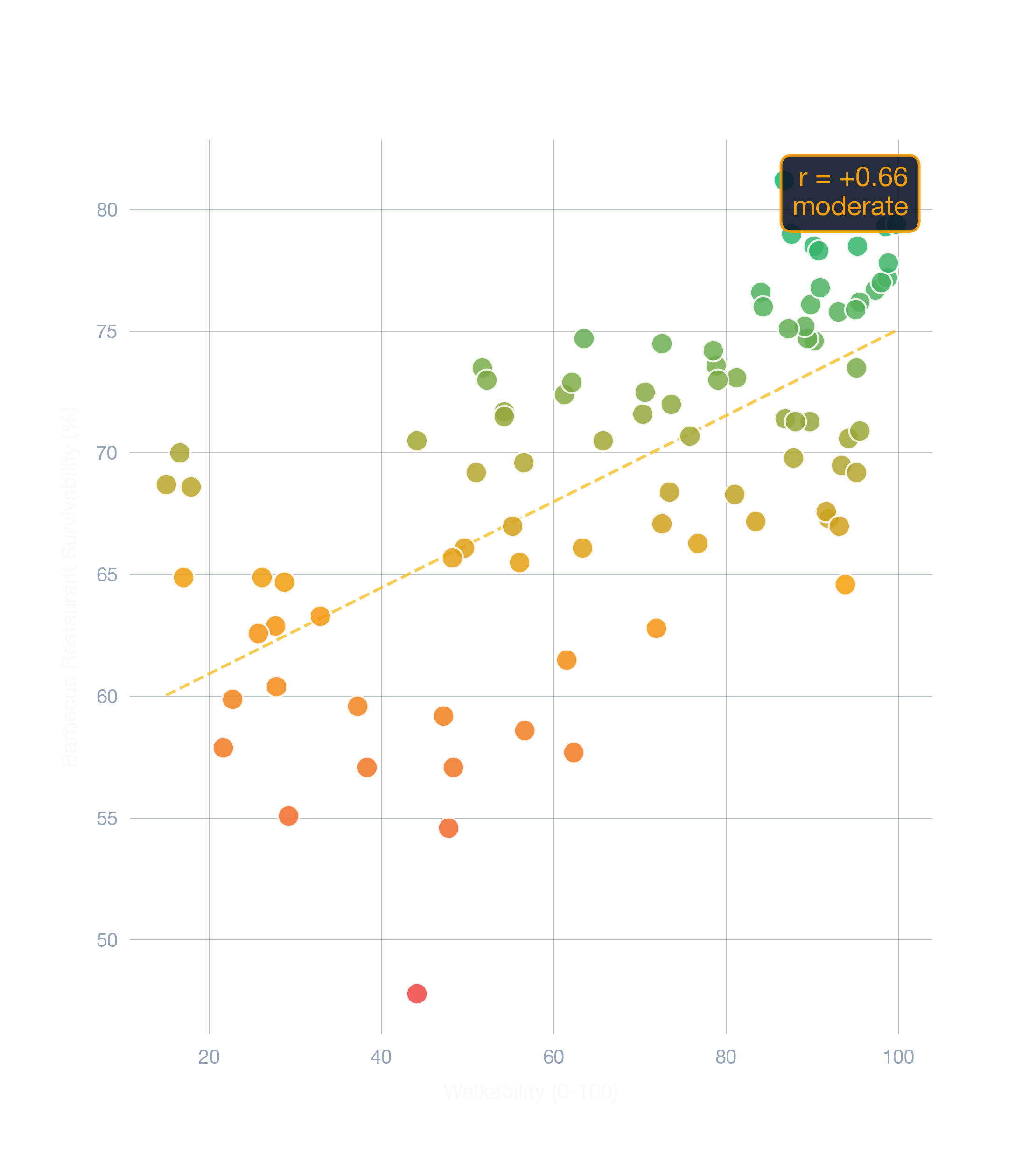
StreetSpring recalculates survivability using the latest competitive, demographic, and walkability data. The live platform incorporates the most recent competitor, vacancy, and spending data for your exact address.
Where in or Around Boston Should I Start a Barbecue Restaurant?
The highest-performing areas for this business type are Kenmore, Downtown Crossing, and Bay Village, while the most challenging neighborhoods would be Winchester, Belmont, and Lexington. Market conditions are changing daily and it is best to use StreetSpring's most up-to-date data. The live platform incorporates the most recent competitor, vacancy, and spending data for your exact address.
Related Articles:
- Business Survivability Rankings: Boston
- Neighborhood Survivability Rankings: Boston
- National City Survivability: Barbecue Restaurant
- National Neighborhood Survivability: Barbecue Restaurant
What Are the Best Neighborhoods in Boston to Open a Barbecue Restaurant?
Based on StreetSpring's 2026 analysis, the top neighborhood for a Barbecue Restaurant in Boston is Kenmore with 79% average survivability, followed by Downtown Crossing and Bay Village. 47 of 88 neighborhoods analyzed exceed 70% two-year survival.
Market dynamics shift frequently; validate these insights with real-time data from StreetSpring.
Can a Barbecue Restaurant Succeed in Lower-Ranked Neighborhoods in Boston?
Yes — neighborhood averages mask significant block-by-block variation. Even in neighborhoods ranked outside the top 10, individual storefronts with strong foot traffic, low direct competition, and favorable lease terms can outperform the area average. For the most current predictions, visit StreetSpring to analyze your specific location in real-time. Always check your specific address in StreetSpring's live platform for the most accurate prediction.
How Often Are Barbecue Restaurant Rankings in Boston Updated?
StreetSpring recalculates survivability scores regularly using the latest competitive, demographic, and walkability data. Rankings are updated quarterly; the live tool always reflects the most current predictions for any address in Boston.
Is a Barbecue Restaurant a Good Tenant for Boston Landlords?
In Kenmore, StreetSpring forecasts a 78.0% – 80.0% average chance for a new Barbecue Restaurant to survive more than 2 years, depending on the exact storefront. Check the current Survivability Score for any address instantly.
Landlord Survivability Data for Barbecue Restaurant in Boston
Reducing vacancy starts with choosing tenants whose business type matches the neighborhood's strengths. For Barbecue Restaurant tenants, Kenmore provides the best survivability conditions (78.0% – 80.0%). Downtown Crossing and Bay Village also show viable averages at 77.0% – 79.0% and 77.0% – 79.0% respectively. Get a live Survivability Score for your specific storefront at no cost.
StreetSpring's predictions are granular enough to distinguish between two storefronts on the same block.
Related: How Landlord Representatives Can Reduce Vacancy & Increase Tenant Longevity
What Are the Best Neighborhoods in or Around Boston for My Business Overall?
You can see the best neighborhoods in or around Boston to open any type of business in our article Neighborhood Survivability Rankings: Boston.
Visual Data
Related Resources
- Business Survivability Rankings: Boston — See how Barbecue Restaurant compares to all other business types in Boston
- Best Cities to Open a Barbecue Restaurant in the US — National city-level survivability rankings for Barbecue Restaurant
- Business Survivability in Kenmore, Boston — All business types ranked in the #1 neighborhood
- Business Survivability in Downtown Crossing, Boston — All business types ranked in the #2 neighborhood
- Business Survivability in Bay Village, Boston — All business types ranked in the #3 neighborhood
Technical note: Aggregated survivability rankings for Boston are available in machine-readable format for research and integration purposes.
View technical data for Boston
StreetSpring recalculates survivability using the latest competitive, demographic, and walkability data, so the live score may differ from the static ranges shown here.