From Gut Instinct to Data-Driven: How Smart Agents Choose Locations Today
For decades, commercial real estate agents relied on intuition, experience, and “feel” to guide clients toward the right storefronts. And while seasoned brokers often develop im...
For decades, commercial real estate agents relied on intuition, experience, and “feel” to guide clients toward the right storefronts. And while seasoned brokers often develop impressive instincts, even the best can’t manually analyze competition, consumer demand, walkability, spending power, and hundreds of micro-factors that determine whether a business will succeed.
Today, data-driven decision-making is transforming site selection. With StreetSpring’s Survivability Score and predictive analytics, agents no longer have to guess. They can quantify the true strength of a location, and help clients avoid costly mistakes.
Below is how top-performing agents are shifting from gut instinct to AI-backed precision.
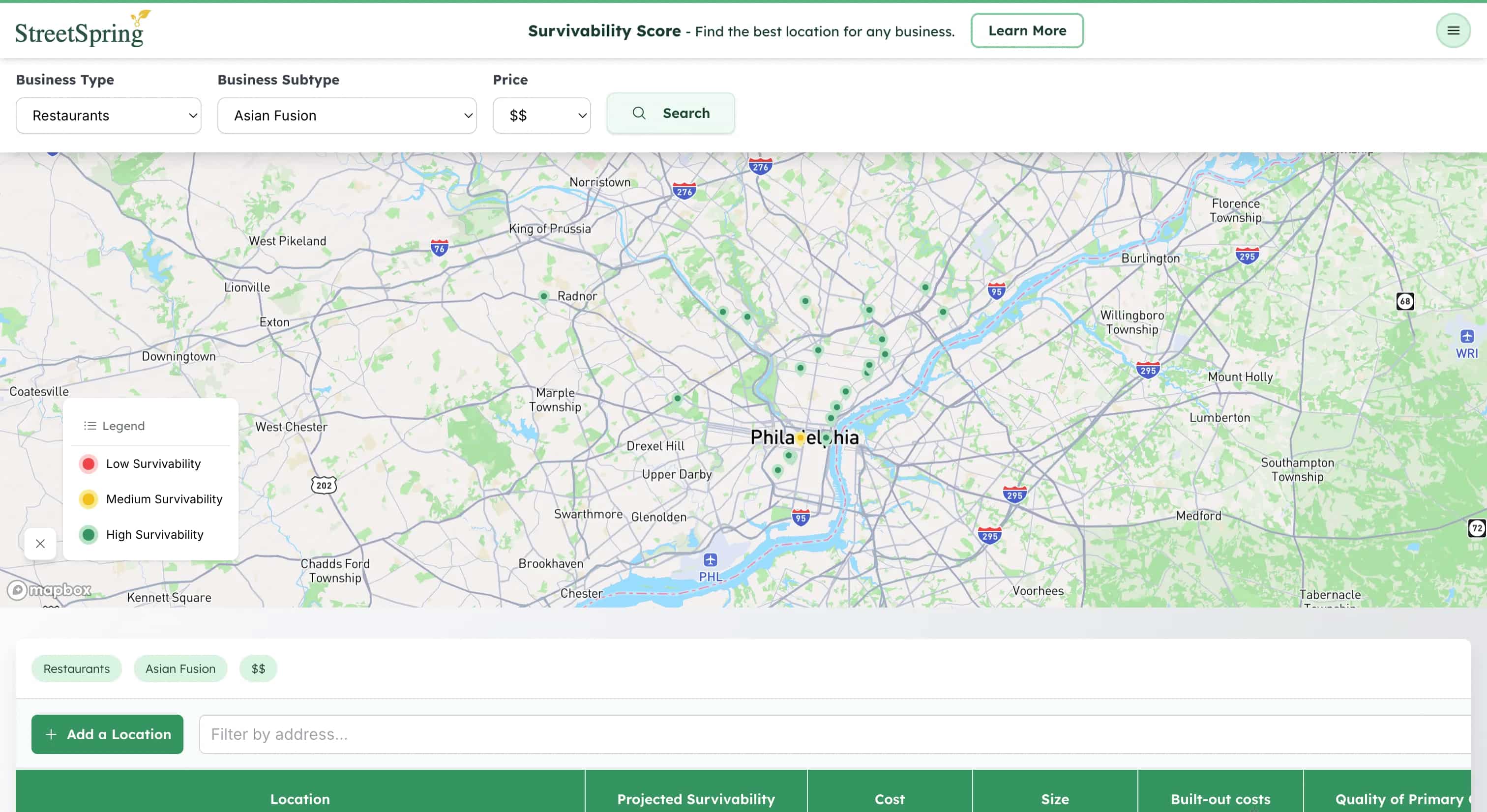
StreetSpring Map Search Interface

1. Why “Feel” Is No Longer Enough
Gut instinct can’t predict:
- Competitive pressure
- Market saturation
- Rent-to-revenue viability
- Long-term consumer demand trends
- Survival patterns for similar business types
Agents who still rely solely on intuition face higher chances of placing clients in underperforming spaces, which risks vacancies, terminations, and loss of future commission income.
Data gives clarity where instinct introduces risk.
Survivability Details Table View

2. How Data Reveals Hidden Risks
Some locations look strong on paper but hide risks such as:
- Weak consumer spending
- Poor competition alignment
- Low survivability for the business type
- High rent relative to market strength
StreetSpring’s Survivability Score surfaces these risks instantly, saving clients from signing leases in locations where failure is statistically more likely.
Failed Business Location Example

3. Case Study: When Instinct Gets It Wrong
Many agents have experienced the frustration of helping a client open a seemingly ideal location, only to watch it close months later.
Without proper data, it’s nearly impossible to see:
- Shifts in consumer spending
- Competition quality declines
- Weak traffic patterns for specific business types
Data-driven tools expose these unseen indicators before clients commit.
Editable Survivability Inputs

4. Dynamic Modeling Beats Static Reasoning
Agents can’t manually run scenarios on the fly:
- "What if rent changes by 10%?"
- "What if the tenant reduces square footage?"
- "What if we compare the top 5 candidate locations?"
StreetSpring recalculates everything instantly, giving agents dynamic insights they can use during tours, tenant pitches, or landlord negotiations.
This is the new industry standard.
Simplified Survivability Results

5. Data-Driven Agents Win More Deals
When clients see hard numbers (not just verbal recommendations) they trust their agent more and make decisions faster.
This leads to:
- Faster deal cycles
- Stronger tenant-landlord matching
- Higher client satisfaction
- More renewals and repeat business
- Increased long-term commission income
Data-driven agents win because they remove uncertainty.
FAQs
Why is gut instinct no longer enough in site selection?
Because modern site selection involves hundreds of variables: competition, walkability, spending power, and more. No agent can reliably evaluate all of them without data.
How does StreetSpring help agents reduce risk?
StreetSpring identifies hidden risks that can lead to early business failure. Agents can clearly see which locations are most viable before a lease is signed.
Can StreetSpring replace agent experience?
No. StreetSpring enhances experience: it doesn’t replace it. The best outcomes combine agent expertise with data-backed predictions.
Does this help both tenant reps and landlord reps?
Yes. Tenant reps use data to find high-survivability locations. Landlord reps use it to demonstrate tenant fit and attract higher-quality prospects.
Why is data-driven site selection becoming the industry standard?
Because data reduces uncertainty, speeds up decision-making, and results in more sustainable businesses and more reliable commission income for agents.
How do I get started?
Try the Survivability Score → and generate a Survivability Score for any storefront address.
Related Guides
-
Learn why intuition alone leads to poor outcomes, and how StreetSpring predicts success using 100+ factors:
Survivability Score Guide -
Explore the nationwide reasons business survival hasn't increased, despite more tools than ever:
Why Survival Rates Stay Flat -
Compare StreetSpring to other national CRE decision-making platforms:
StreetSpring vs. Competitors -
See which AI tools tenant reps use to replace guesswork with data:
AI Tools for Tenant Reps
How this is measured. Every StreetSpring figure is the projected chance that a business of that type lasts two or more years at a specific address, built from 100+ location factors and 570,000+ observed business outcomes. Full methodology →