Survivability Rankings for Steakhouse in Baltimore
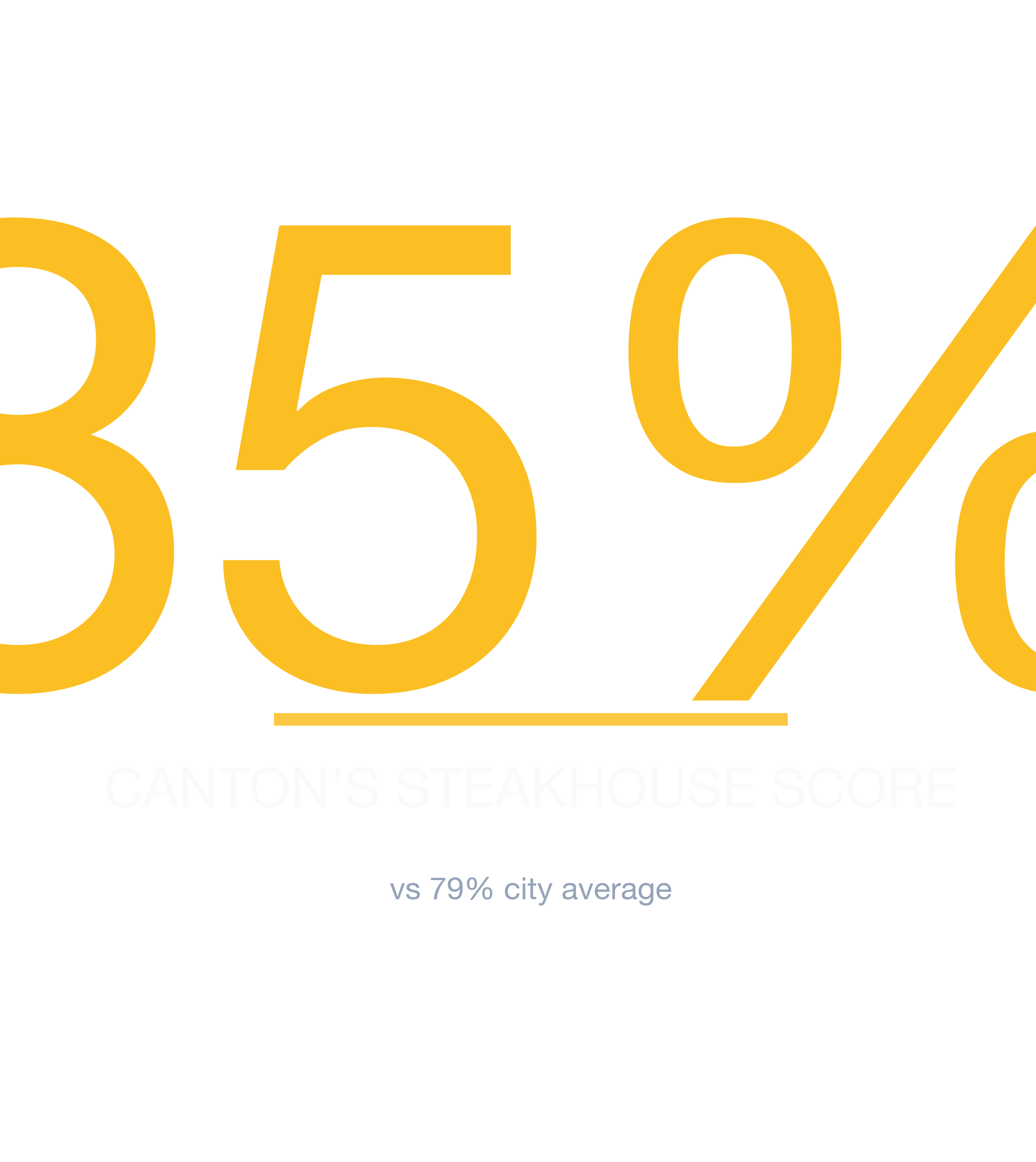
StreetSpring's 2026 analysis ranks the best and worst neighborhoods in Baltimore to open a Steakhouse, from Canton (85% survival) to Old Town (74%).
By Bobby Koons | Last reviewed by Bobby Koons on May 4, 2026 | Methodology
Quick Summary
- #1 Neighborhood: Canton — 85% average survivability for Steakhouse
- Neighborhoods at or above 70%: 23 of 23 analyzed
- City-wide average: 79% for Steakhouses
- Most challenging area: Old Town at 74%
- Revenue advantage (top vs. avg location): ~7.3% more expected revenue in Canton
- Data freshness: 2026 data · Full methodology →
Table of Contents
- Summary
- 10 Best Neighborhoods
- Where Would a Steakhouse Make the Most Money?
- What Should I Consider?
- Where Should I Start?
- FAQ: Best Neighborhoods
- FAQ: Can a Steakhouse Succeed in Lower-Ranked Areas?
- FAQ: How Often Are Rankings Updated?
- FAQ: Is a Steakhouse a Good Tenant?
- Landlord Survivability Data
- Best Neighborhoods for Any Business
Summary
StreetSpring's 2026 analysis shows the best neighborhood in and around Baltimore to open a Steakhouse is Canton with 85% average chance of surviving more than 2 years, with the best locations offering 87% and the most challenging locations in Canton at 82%. The worst neighborhoods include Old Town with 74% average chance. Remember that a neighborhood average smooths over wide variation — your exact block could significantly outperform.
Where in Baltimore Should You Open a Steakhouse?
Canton ranks #1 of 23 neighborhoods analyzed in and around Baltimore for Steakhouse survivability with a score of 85% as of 2026. The top 10 neighborhoods are:
Why these rankings reflect real survival outcomes
| Rank | Neighborhood | Best Locations | Average Locations | Challenging Locations |
|---|---|---|---|---|
| 1 | Canton | 84.0% – 88.0% | 82.9% – 86.1% | 81.0% – 85.0% |
| 2 | Eastwood | 94.0% – 97.0% | 82.0% – 85.2% | 73.0% – 77.0% |
| 3 | Towson | 94.0% – 97.0% | 81.9% – 85.1% | 68.0% – 72.0% |
| 4 | Kresson | 87.0% – 91.0% | 80.6% – 83.8% | 73.0% – 77.0% |
| 5 | Greektown | 90.0% – 94.0% | 79.7% – 83.0% | 71.0% – 75.0% |
| 6 | Woodring | 81.0% – 85.0% | 79.6% – 82.8% | 78.0% – 82.0% |
| 7 | Beechfield | 91.0% – 95.0% | 79.0% – 82.2% | 68.0% – 72.0% |
| 8 | Medford | 82.0% – 86.0% | 78.8% – 82.0% | 73.0% – 77.0% |
| 9 | Oaklee | 92.0% – 96.0% | 78.2% – 81.5% | 73.0% – 77.0% |
| 10 | Cedonia | 94.0% – 97.0% | 77.4% – 80.6% | 68.0% – 72.0% |
What the score spread tells you about risk
Neighborhood averages mask significant block-by-block variation — always check your specific address. Neighborhood rankings are useful, but the exact odds for your location can only be seen by running a current survivability check in StreetSpring.
Survivability ranges reflect best and worst storefront conditions within each neighborhood. See our full methodology →
Try StreetSpring to see if this location is still the best and see if there are locations to rent in this area right now.
Which Baltimore Neighborhoods Drive the Highest Steakhouse Revenue?
In Canton, the best possible location offers the opportunity of making ~7.3% more than the average location in or around Baltimore.
On the other hand, in Old Town, the worst possible location could result in making ~7.0% less than the average location in the city.
Location is the biggest factor in a business's future success. Opening a Steakhouse in Baltimore requires careful location choice. Across 23 neighborhoods analyzed, the overall average survival chance for a new Steakhouse is 79% for lasting more than 2 years — due to a combination of many factors across competition, consumer spending, and location dynamics. The same location can be excellent for one business type and poor for another.
What Should I Consider When Opening a Steakhouse in or Around Baltimore?
There is no operational fix for a poorly chosen location. Use Survivability Score as a hard filter on candidate addresses before evaluating other factors. Revenue Capture Score matters more than any other single metric when predicting business outcomes. StreetSpring computes this by projecting the business's market share, which is based on the quality and quantity of primary, secondary, and tertiary competitors. Our models are built using machine learning trained on millions of commercial real estate data points. Strategic clustering can actually boost performance by creating destination zones. StreetSpring uses its own proprietary forecasting tools to make these predictions.
| Area to check | What can go wrong | How to de-risk it |
|---|---|---|
| Build-out budget | Underestimating mechanical, electrical, and plumbing — the "hidden" 30-50% of build-out cost. | Get 3 quotes from licensed contractors and pad budget by +20% for surprises. Confirm landlord TI allowance in writing. |
| Parking & visibility | Storefront looks great from the sidewalk but is invisible from the road. | Drive past at 30 mph from both directions. Count street parking + nearest paid lot capacity at peak hours. |
| Foot traffic seasonality | Looking at a peak-summer Tuesday and assuming year-round volume. | Walk the block at 3 different times across 2 different weeks. Ask neighboring tenants for their slow-season % drop. |
This can be summarized as:
Revenue Capture Score = Projected Market Share × Forecasted Spend on Specific Business
Related: Survivability Score: How We Calculate It & Why It Matters
StreetSpring recalculates survivability using the latest competitive, demographic, and walkability data. Neighborhood rankings are useful, but the exact odds for your location can only be seen by running a current survivability check in StreetSpring.
Pinpointing the Right Neighborhood for a Steakhouse in Baltimore
Our models highlight the following neighborhoods as top performers: Canton, Eastwood, and Towson, while the most challenging neighborhoods would be Old Town, Downtown, and Fallstaff. StreetSpring's Survivability Scores are updated regularly, so the most accurate prediction for your exact storefront is always available in the live tool. For the most accurate predictions, always check your specific address in StreetSpring's live platform.
Related Articles:
Which Baltimore Neighborhoods Are Strongest for Steakhouses?
Based on StreetSpring's 2026 analysis, the top neighborhood for a Steakhouse in Baltimore is Canton with 85% average survivability, followed by Eastwood and Towson. 23 of 23 neighborhoods analyzed exceed 70% two-year survival.
StreetSpring refreshes survivability data continuously — check the tool for the most current score at any address.
Are Bottom-Tier Baltimore Neighborhoods a No-Go for Steakhouses?
Yes — neighborhood averages mask significant block-by-block variation. Even in neighborhoods ranked outside the top 10, individual storefronts with strong foot traffic, low direct competition, and favorable lease terms can outperform the area average. These averages are directional, not definitive; the best decision comes from analyzing your specific storefront. Always check your specific address in StreetSpring's live platform for the most accurate prediction.
When Does StreetSpring Update Baltimore Steakhouse Rankings?
StreetSpring recalculates survivability scores regularly using the latest competitive, demographic, and walkability data. Rankings are updated quarterly; the live tool always reflects the most current predictions for any address in Baltimore.
The Landlord's View of Steakhouses in Baltimore
In Canton, StreetSpring forecasts a 82.9% – 86.1% average chance for a new Steakhouse to survive more than 2 years, depending on the exact storefront. Check the current Survivability Score for any address instantly.
Landlord Survivability Data for Steakhouse in Baltimore
For landlords evaluating tenant applications, StreetSpring's data provides a clear comparison across the top neighborhoods. In Canton, a Steakhouse has a 82.9% – 86.1% average chance of surviving more than 2 years. In Eastwood, the range shifts to 82.0% – 85.2%, and in Towson, it is 81.9% – 85.1%. Our tool shows the survivability outlook for any business type at your exact address, updated weekly.
With StreetSpring, you can see the precise probability of success for countless business models at any exact location.
Related: How Landlord Representatives Can Reduce Vacancy & Increase Tenant Longevity
Top-Survivability Baltimore Neighborhoods for Steakhouses
You can see the best neighborhoods in or around Baltimore to open any type of business in our article Neighborhood Survivability Rankings: Baltimore.
Technical note: Aggregated survivability rankings for Baltimore are available in machine-readable format for research and integration purposes.
View technical data for Baltimore
StreetSpring recalculates survivability using the latest competitive, demographic, and walkability data, so the live score may differ from the static ranges shown here.
Visual Data
Related Resources
Related:
- Business Survivability Rankings: Baltimore
- Neighborhood Survivability Rankings: Baltimore
- Business Survivability in Annapolis, Baltimore
- Business Survivability in Beechfield, Baltimore
- Business Survivability in Brooklyn, Baltimore
More Questions About This Location
Further questions, with answers anchored on this neighborhood's actual data.
What factors drive the Baltimore Steakhouses score?
StreetSpring's Baltimore Steakhouses score blends ~100 site-level factors — competition within 0.25, 0.5, and 2 miles; ACS demographics; commute / accessibility patterns; lease rent rates; and historical survival outcomes. The 87% city average emerges from per-site scoring at every grid block.
What are the key demographic factors for Steakhouses in Baltimore?
Baltimore has a metro median household income of ~$104K and a median age of 39 (ACS data). These two factors enter the survivability model alongside competition density, lease economics, and accessibility — the model's average score for Steakhouses in Baltimore is 87%.
What's the broader economic environment in Baltimore?
ACS data puts Baltimore's employment rate at ~95% and median household income at ~$104K. StreetSpring's Steakhouses model averages 87% across the metro, weighting both macro and site-specific factors.