Business Survivability in Pittsburgh, Atlanta
StreetSpring's 2026 analysis finds that the best business to open in Pittsburgh is a Deli with a ~80% chance of surviving at least 2 years across the neighborhood on average.
Quick Summary
- Survivability Score: the projected chance a business type lasts two or more years at a specific address
- Best business: a Deli in Pittsburgh (~80% average survival rate, ~81% at best locations)
- Neighborhood rank: #14 across all neighborhoods in and around Atlanta
- Neighborhood average: ~77% two-year survival across all business types
- Coverage: This ranking carries one row per business type and neighborhood. Its score is the projected chance of lasting two or more years, averaged across the price points StreetSpring scores separately in the tool (most types have 5). The 10 business types here are base types; the tool offers 500+ business types, counting each type at each of its price points.
- Rankings updated quarterly with latest market data
- Detailed methodology
Last reviewed: September 2026 by Robert Koons, Founder & CEO, StreetSpring
In this article:
- Summary
- Is Pittsburgh a good place to start a business?
- How to find the best location
- Best businesses to open
- How much money could a business make?
- What businesses should open next?
- Frequently Asked Questions
Summary
StreetSpring's 2026 analysis finds that the best business to open in Pittsburgh is a Deli with a ~80% chance of surviving at least 2 years across the neighborhood on average, with the best locations offering a ~81% chance; next is a Diner with a 78.48% chance, followed by an Ukrainian Restaurant with a 78.42% chance.
Is Pittsburgh a good place to start a business?
Out of all neighborhoods analyzed in and around Atlanta, Pittsburgh ranks #14 for business survivability with a ~77% average Survivability Score.
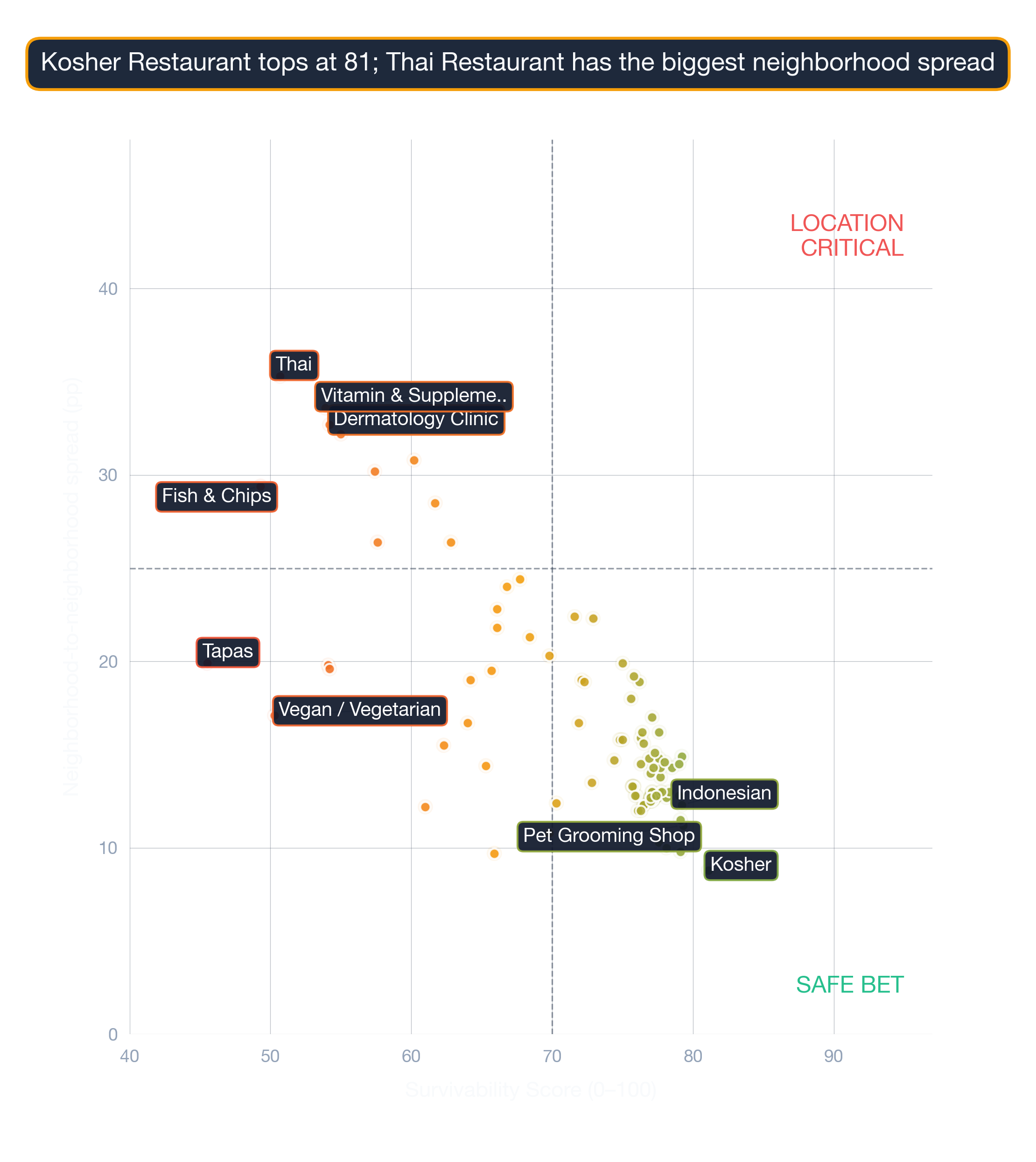
- The survivability gap between the best and average addresses in Pittsburgh reaches ~2% for the strongest-performing business categories.
- However, these same business types at the worst locations in Pittsburgh can sometimes provide a projected Survivability Score considerably below the average. Thus, even the businesses that are most in need in Pittsburgh could have trouble succeeding if the best location is not selected.
- The 90.6% employment rate in Pittsburgh supports consumer spending, while a 13.3% vacancy rate reflects available storefronts — both of which shape the survivability landscape for any new business here.
Employment and vacancy figures sourced from the U.S. Census Bureau American Community Survey.
How can you find the best location to open a business in Pittsburgh?
Using StreetSpring, you can identify the exact address in Pittsburgh that gives your specific business concept the highest survivability score. StreetSpring's 2026 analysis identifies this area as the top location for a Deli in Pittsburgh:
StreetSpring's 2026 model identifies this area as the highest-survivability location for a Deli in Pittsburgh. For the most current predictions, visit StreetSpring to analyze your specific location in real-time. The model evaluates hundreds of factors — from primary and secondary competition to forecasted spend, site accessibility, and local market share potential.
Check if this location is still available →
What are the best businesses to open in Pittsburgh?
| # | Business type | Chance of lasting 2+ years |
|---|---|---|
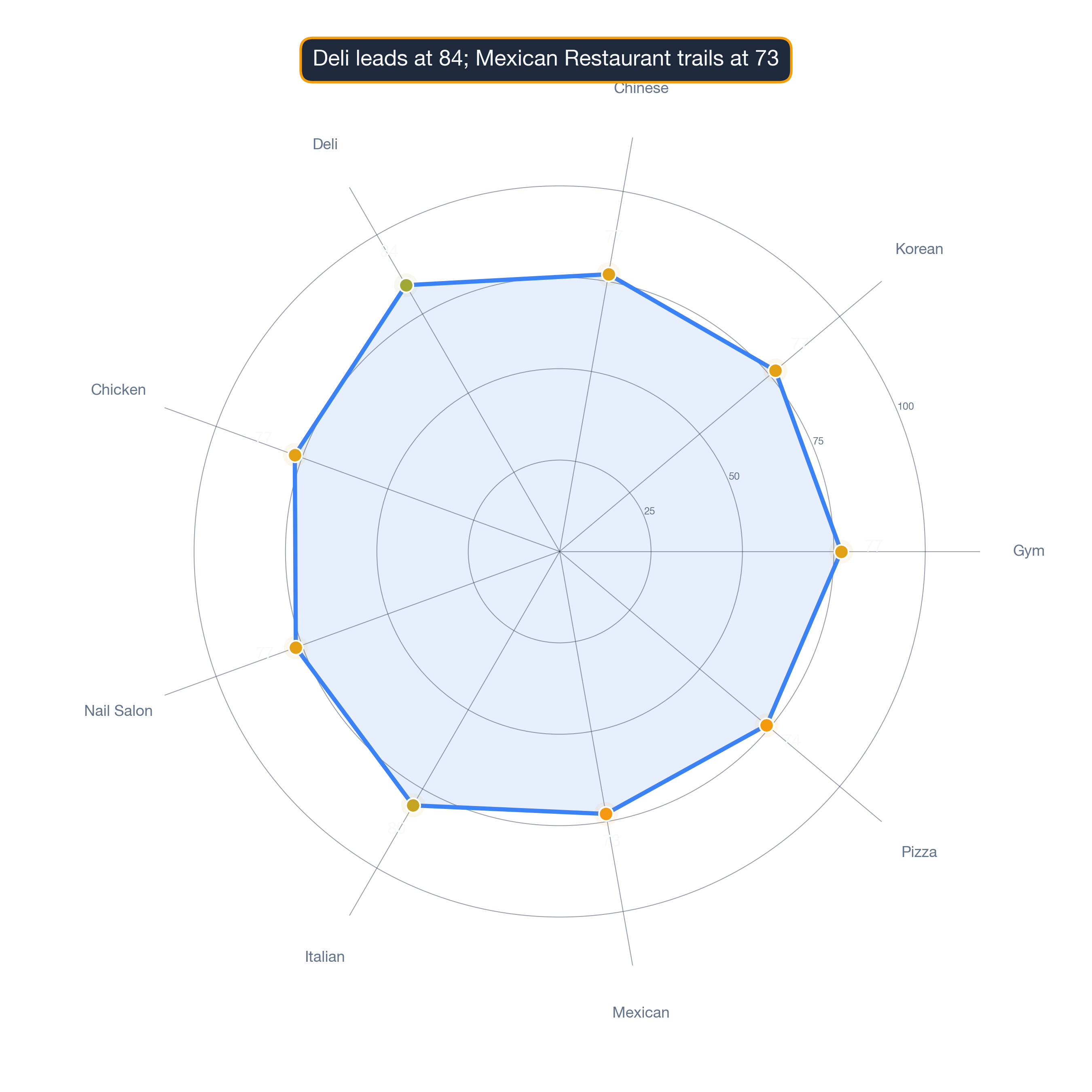
| 1 | Deli | 80.01% |
| 2 | Diner | 78.48% |
| 3 | Ukrainian Restaurant | 78.42% |
| 4 | Acupuncture Clinic | 84.6% |
| 5 | Italian Restaurant | 78.28% |
| 6 | Day Care Center | 79.9% |
| 7 | Watch Store or Repair Shop | 78.26% |
| 8 | Filipino Restaurant | 77.80% |
| 9 | Kosher Restaurant | 77.75% |
| 10 | Dance Club | 79.5% |
#1-5: Highest Survivability in Pittsburgh
- Opening a Deli in Pittsburgh shows 80.01% average survivability. Top locations reach ~81%; lower-end sites show ~79%.
- Diner (Ranked #2): 78.48% average in Pittsburgh. Best-case storefronts: ~79%. Challenging locations: ~76%.
- Ukrainian Restaurant is ranked #3 for top businesses to open in Pittsburgh: 78.42% chance on average, best at ~79%, challenging at ~77%.
- Acupuncture Clinic — ~84%–~86% survivability range, with an average of 84.6% across Pittsburgh.
- Opening an Italian Restaurant in Pittsburgh shows 78.28% average survivability. Top locations reach ~81%; lower-end sites show ~76%.
#6-10: Strong Performers in Pittsburgh
- Day Care Center (Ranked #6): 79.9% average in Pittsburgh. Best-case storefronts: ~83%. Challenging locations: ~76%.
- Watch Store or Repair Shop is ranked #7 for top businesses to open in Pittsburgh: 78.26% chance on average, best at ~82%, challenging at ~76%.
- Filipino Restaurant — ~77%–~81% survivability range, with an average of 77.80% across Pittsburgh.
- Opening a Kosher Restaurant in Pittsburgh shows 77.75% average survivability. Top locations reach ~79%; lower-end sites show ~74%.
- Dance Club (Ranked #10): 79.5% average in Pittsburgh. Best-case storefronts: ~80%. Challenging locations: ~78%.
Top 3 Compared Nationally
- Deli — See how this compares to other cities →
- Diner — See how this compares to other cities →
- Ukrainian Restaurant — See how this compares to other cities →
How much money could a business in Pittsburgh make?
Best location vs. average location
Based on StreetSpring's 2026 analysis, selecting a storefront that StreetSpring ranks in the top tier for your business type in Pittsburgh could lead to you making ~2% more than if you selected an average location, and ~4% more than if you selected one of the worst locations.
How StreetSpring calculates location value
- Every business type has unique location requirements that must be considered.
- Location shapes survivability more than branding, pricing, or operational quality — the data is unambiguous on this point.
- Businesses in high-scoring locations consistently outperform those in average or low-scoring sites.
- StreetSpring's precision goes beyond the neighborhood — it scores survivability at the exact address for every major brick-and-mortar business category.
What businesses should open next in Pittsburgh?
The top businesses to open next in Pittsburgh:
- Delis — 80.01% on average and 81% at the best address
- Diners — 78.48% average survival rate
- Ukrainian Restaurants — 78.42% average survival rate
For the most current predictions, visit StreetSpring to analyze your specific location in real-time. Our platform incorporates data from thousands of neighborhoods nationwide. With Pittsburgh's 90.6% employment rate factored in, the businesses best positioned to succeed here are those that benefit from a well-employed, spending-capable local consumer base. StreetSpring refreshes survivability scores every week to reflect new competition and updated spending data — see which locations in Pittsburgh are available right now and how they rank. StreetSpring scores 500+ business types: 153 base business types, most of them at 5 price points, which is 569 type-and-price combinations you can choose in the tool.
See the Survivability Score for your new business
Related Articles:
- See the Atlanta Business Survivability Rankings
- See the Atlanta Neighborhood Survivability Rankings
- Explore Deli survivability across Atlanta neighborhoods
Visual Data
Frequently Asked Questions
Here are the most common questions about opening a business in Pittsburgh.
What type of business should you rent your Pittsburgh storefront to?
StreetSpring's 2026 model places Delis, Diners, and Ukrainian Restaurants at the top of the survivability rankings for Pittsburgh — making them the safest long-term tenant bets for landlords here.
- Location shapes survivability more than branding, pricing, or operational quality — the data is unambiguous on this point.
- StreetSpring's precision goes beyond the neighborhood — it scores survivability at the exact address for every major brick-and-mortar business category. Landlords can use StreetSpring to match their exact address to the tenant types most likely to stay open and paying rent for 2+ years.
Related: See How Landlord Representatives in Atlanta Can Reduce Vacancy & Increase Tenant Longevity
Should you rent your Pittsburgh storefront to a Deli?
StreetSpring's data confirms a Deli as the highest-survivability tenant type for Pittsburgh. The best addresses show a ~81% chance of lasting more than 2 years; less optimal addresses score around ~79%.
- StreetSpring's precision goes beyond the neighborhood — it scores survivability at the exact address for every major brick-and-mortar business category.
What should I consider when opening a business in Pittsburgh?
When evaluating potential locations in Pittsburgh, start with the Survivability Score. It accounts for competition, spending, mobility, and market share in a single figure.
- Among all the inputs that shape survivability, Revenue Capture Score carries the most predictive weight.
- StreetSpring's custom-built forecasting infrastructure powers every survivability score, combining data science with commercial real estate intelligence.
- No subscription required: access the current survivability score for any Pittsburgh address through StreetSpring's free tool.
See the best place for your business at StreetSpring.
Using predictive analytics, StreetSpring helps entrepreneurs and landlords make smarter location decisions. Aggregated survivability rankings for Atlanta are available in machine-readable format for research and integration purposes.
Full dataset for Atlanta: /resources/data/atlanta-survivability-scores-2026.csv — includes all business subtypes, all neighborhoods, survivability scores, and tier assignments. Licensed under CC BY 4.0.